
Wikimedia Commons
Hieroglyphics
Hieroglyphics
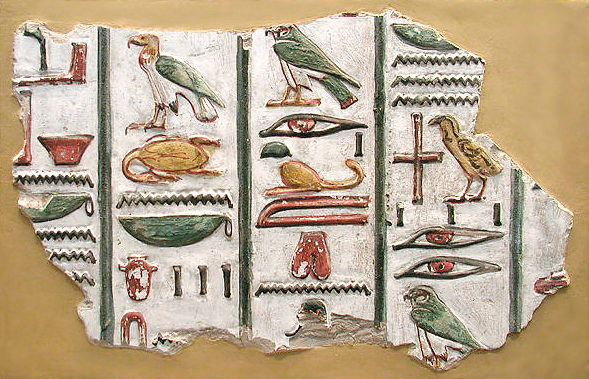
Long ago in ancient Egypt, people wrote using small pictures called hieroglyphs. Each picture could stand for a sound, a word, or an idea. The Egyptians used this writing for over 3,000 years. You can still see hieroglyphs carved on old temples and tombs today.
How It Worked
Hieroglyphics used more than 700 different pictures. Some showed animals, like birds and snakes. Others showed people, tools, or plants. A picture could mean a sound, like a letter in our alphabet. It could also stand for a whole word. Writing could go from left to right, right to left, or top to bottom. Readers looked at the way the animals faced to know which way to read.
Who Used It
Only a few people in Egypt knew how to read and write hieroglyphs. These people were called scribes. Boys went to special schools to learn. Scribes wrote on stone walls, clay, and a paper called papyrus. They wrote stories, prayers, and letters. They also kept track of food, workers, and taxes for the king.
The Rosetta Stone
For a long time, no one could read hieroglyphs. The secret was lost for about 1,400 years. Then in 1799, soldiers found a big rock called the Rosetta Stone. It had the same message in three kinds of writing. A smart man named Jean-Francois Champollion used it to crack the code in 1822. Now we can read what the ancient Egyptians wrote.
Fun Facts
- The word hieroglyph means sacred carving in Greek.
- Kings' names were written inside an oval shape called a cartouche.
- Some hieroglyphs look like owls, feet, and tiny chairs.
Did You Know?
The ancient Egyptians did not use any spaces or punctuation in their writing, so the words all ran together in long lines of pictures!

You finished the article! Great job!