
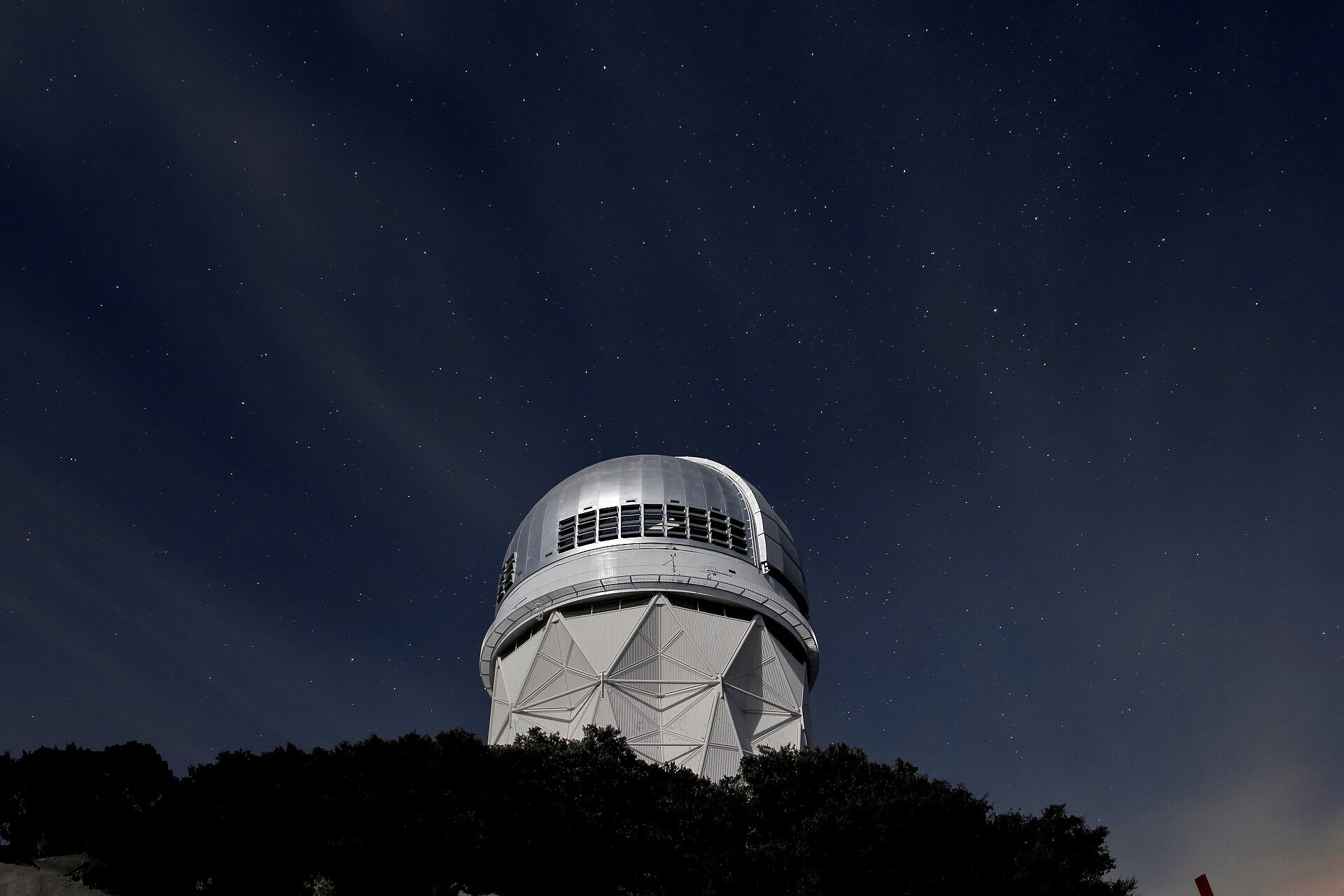
KPNO/NOIRLab/NSF/AURA/P. Marenfeld / Wikimedia Commons
Stars
Stars
Stars are enormous balls of hot gas, mostly hydrogen and helium. Deep inside a star, pressure and heat are so intense that atoms join together and release energy. That energy makes stars shine across space.
Star Colors
Stars come in different colors because they have different temperatures. Red stars are cooler than the Sun. Yellow stars, like the Sun, are hotter. The hottest common stars glow blue or blue-white, not red or orange.
Giant Stars
Some stars are much larger than the Sun. Red supergiants can swell so wide that, if one replaced the Sun, it could reach far into the inner solar system. These giant stars do not live as long as smaller stars because they burn through fuel quickly.
Changing Stars
Not all stars shine steadily. Some stars pulse, brighten, and dim in regular patterns, almost like cosmic heartbeats. These are called variable stars. Astronomers use some variable stars to measure distances across space.
Fun Facts
- The Sun is a star, and it is the closest star to Earth.
- Stars are born inside huge clouds of gas and dust called nebulae.
- When massive stars die, they can explode as supernovae.
Did You Know?
When you look at stars, you are seeing light that may have traveled for years, hundreds of years, or even much longer before reaching your eyes.

You finished the article! Great job!